The Banana Ball Championship League (BBCL) is a six-team, points-based touring baseball league run by Fans First Entertainment and anchored by the Savannah Bananas. Its 2026 World Tour runs February 26 through October 10 across 75 stadiums in 45 states, with semifinals at Grayson Stadium and the Banana Bowl at Nationals Park on October 10. Games follow 11 official rules built for speed and spectacle, but outcomes are unscripted and competitive even though the entertainment around them is planned.
BBCL Competitive Integrity Versus Theater
The Banana Ball Championship League is a competitive unscripted baseball league with planned entertainment wrapping. Treating BBCL as pure theater leads fans to dismiss standings, playoffs, and the Banana Bowl as kayfabe, while treating it as a quiet traditional league creates false expectations about dead innings and solemn roster continuity. Jesse Cole has stated that entertainment segments are planned but game outcomes are not scripted. The 2026 format locks that hybrid in place with six touring teams, formal standings, semifinals, and a championship game. Trick plays are tracked as statistics and can unlock the Equalizer Point, but they do not individually score and do not predetermine the result.
The competitive machinery runs on unscripted outcomes, inning points, standings, top-four playoffs, and a top-two Banana Bowl. Sports-theater cues appear in choreographed bits, the Savannah Bananas brand, and YouTube and ESPN discovery. The other 2026 clubs—Party Animals, Firefighters, Texas Tailgaters, Indianapolis Clowns, Loco Beach Coconuts—exist only as proof the product is a league, not as a directory.
Watch BBCL as real competition inside a show envelope. Win-loss stakes exist, but do not expect MLB-style quiet or roster solemnity. It is not baseball, it is a variety show with a bat.
2026 BBCL World Tour Structure
The 2026 Banana Ball Championship League season is a February-to-October World Tour with six teams, formal standings, and a fixed playoff calendar rather than a one-city exhibition run. Misreading it as only a Savannah Bananas road show hides how the Party Animals and four other clubs share a 75-stadium, 45-state map. The calendar concentrates the competitive climax in two Savannah windows and one MLB-park finale. Season play opens February 26–28, 2026 in Tallahassee among Firefighters, Party Animals, Bananas, and Tailgaters, then funnels the top four into the Banana Ball Open and later the Grayson Stadium playoffs.
| Stage | Dates | Site | Field |
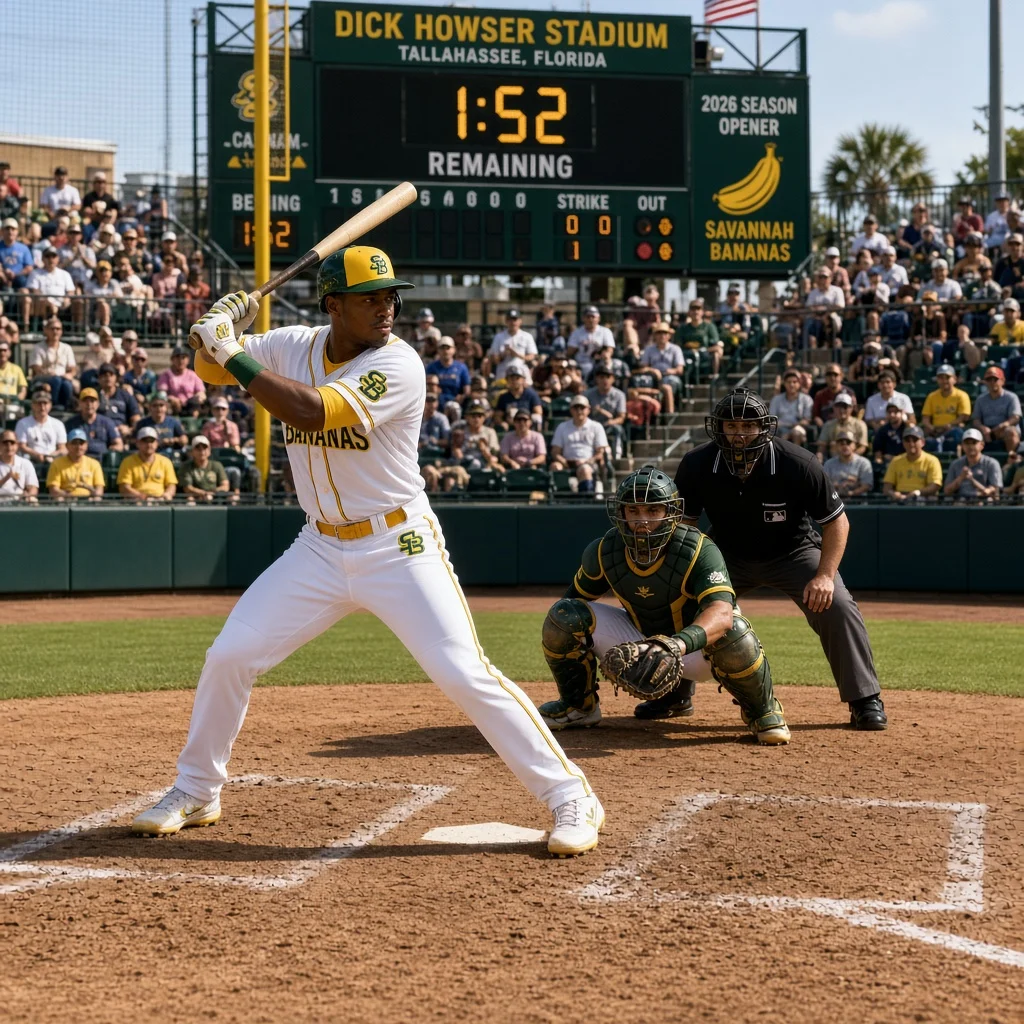
| Season open | Feb 26–28, 2026 | Tallahassee | Dick Howser Stadium and Doak Campbell Stadium; Firefighters, Party Animals, Bananas, Tailgaters |
| Banana Ball Open | Apr 16–19, 2026 | Grayson Stadium | Top four teams only |
| BBCL Playoffs | Oct 1–4, 2026 | Grayson Stadium | Top four |
| Banana Bowl | Oct 10, 2026 | Nationals Park, Washington, D.C. | Top two |
The Bananas still take the heaviest road load and marquee MLB stops, but April’s Open and October’s playoffs are separate top-four events, and the championship is a single game at Nationals Park—not a Savannah home finale.
Banana Ball Points and Clock
Banana Ball awards inning points under a two-hour clock rather than totaling runs. Fans who keep a conventional run line will misread who is winning and why a two-hour clock can freeze a comeback. No new inning may start after two hours; an inning already underway is played to completion. The official one-sheet lists exactly 11 rules, including an automatic strike for leaving the box, ejection for bunting, the Ball-Four Sprint, fan-caught foul outs, one coach challenge plus one fan challenge, and one Golden Batter use per team. Lineups may run 10 spots with a DH and Extra Hitter, and the Equalizer Point can give the visitors one bonus point before the last inning if they lead in trick plays. Seven fielders must touch the ball on a Ball-Four Sprint; staff catches of fouls do not count as fan-catch outs; a DH who enters the field keeps the same batting spot.
Fans First Lottery Group Caps
The Fans First Tickets lottery is a sequenced, group-gated purchase window with a hard per-account cap, not an open onsale that later dumps leftovers into a public pool. Parties who treat it like a normal ticket drop lose contiguous seats or never receive a buy link. Official pages describe fee-free pricing and an email purchase window; they do not document how many groups a city is split into, how invitations cascade, or what happens when a household needs more than five tickets. In practice, buyers report assignment to one of about 11 designated groups, limited waves, and a cap of five tickets per account, often covering just two games.
- Cities split into designated lottery groups, with fans reporting about 11
- Invitations cascade through those groups rather than unlocking everyone at once
- Strict per-account cap of five tickets, often for two games
- Larger families must coordinate multiple accounts and still may not sit together
- Unsold inventory after earlier waves is not reliably released as a general public pool
Contiguous seating is the scarce resource. Leftover stock does not equal a second-chance onsale.
Premium Seating Versus Early Arrival
Premium seating tiers now reserve the best views at some Banana Ball Championship League venues for higher-priced tickets, so early arrival no longer converts a general-admission pass into a front-row seat. Budget fans who still plan around the old first-come map will spend hours in line for leftover angles. General admission remains advertised around $35 fee-free, while better seats are sold as premium in the neighborhood of $125 at venues that have made the split. The product is therefore a hybrid of flat-price GA and partial reserved seating, not a pure first-come bowl.
Early arrival still sorts the remaining GA bowl, but it cannot reclaim sections now marked premium. Long-time fans experience this as a break from the no-price-hike, fans-first map. The organization claimed they would never raise ticket prices. While general admission remains at $35, the seating arrangement has changed. If fans want better seats, they can no longer just arrive early; they must pay $125 for ‘premium seats.’
Large-Stadium Banana Ball Cost Stack
Headline Banana Ball ticket pricing for MLB and large-stadium events is typically $35–$40 fee-free general admission, but the workable in-venue cost often includes club or all-inclusive hospitality that multiplies that number. Arriving with only the advertised ticket can mean weak sightlines, long lines, and no escape from the noise floor. Those add-ons are optional on paper and functionally required at some parks for a tolerable experience. One documented National Car Rental Club all-inclusive package ran about $350 per person, bundling buffet and drinks at roughly ten times the base ticket.
| Cost layer | Reported amount | What it buys |
| Base GA | $35–$40 fee-free | Headline ticket, often weaker views at big parks |
| Premium reserved | About $125 | Better seats that used to be first-come GA |
| Club all-inclusive | About $350 per person | One MLB-venue hospitality example bundling buffet and drinks |
Per-person spend at large venues can dwarf the marketing price. It varies by park, and $350 is a single reported data point, not a league average. I ended up purchasing the National Car Rental Club All‑Inclusive for $350, which covers a buffet, beer, wine, and soft drinks.
BBCL Noise and Sensory Load
Banana Ball’s soundscape is a design feature: near-constant music with tracks swapping every 12 to 45 seconds and almost no conversational downtime between bits. Families who expect a conventional ballpark’s quiet half-innings will hit sensory overload, especially with toddlers. The cadence is closer to a continuous highlight reel than to nine innings of ambient crowd noise. Official explainers call the product fast and fan-inclusive but do not publish decibel ranges, song-change intervals, or quieter sections. Noise-sensitive fans need a plan for ear protection, aisle seats, or leaving early rather than waiting for a lull that may not come.
Ear protection for toddlers, sitting where an exit is usable, and not banking on a quiet inning under the two-hour, points-and-bits format are the practical moves. The cadence exists because planned entertainment fills every gap so the show never goes dead.
I noticed many young kids and toddlers covering their ears as the music blasted nonstop throughout the two‑hour game, with tracks changing every 12 to 40 seconds… it felt like a fever dream—someone seemed to be hooked to the Aux and scrolling through TikToks… there’s no chance to chat with friends or family during the game, leaving you drained instead of energized.
BBCL Player Pay Versus Workload
Player compensation in the Banana Ball Championship League is not published against the length of the tour, the travel density, or the extra physical risk of on-field stunts, so the public salary picture is incomplete. Prospective players who price the job like a short independent-ball season will undercount months on the road and performance demands beyond baseball. Community reports cite figures around $1,00,000 per year even as the 2026 World Tour spans February 26 to October 10 across 75 stadiums. That schedule, plus trick plays and entertainment obligations, is the workload any pay figure has to be judged against—not a conventional minor-league calendar.